- No. 45 N20 Road, Long Phuoc Ward, Ho Chi Minh City
- Admin@CTCinternimex.com



- Gợi ý từ khóa:
Export agricultural products, wood export, coffee export, …


Green Pomelo: Proven Post-Harvest Steps for Best Reefer Export 2026
Green pomelo (Citrus maxima / Citrus grandis), particularly the renowned Vietnamese Da Xanh cultivar, has become a high-value citrus commodity across international markets. Global produce distributors, supermarket procurement teams, and boutique fruit retailers consistently favor this variety for its emerald rind, crisp ruby-pink vesicles, and balanced sweet-tart flavor profile.
However, moving fresh fruit across ocean routes spanning 20 to 45 days presents serious physiological risks. Unconditioned citrus can suffer from skin yellowing, stem-end rot, moisture loss, and transit blemishes. With nearly two decades of agricultural export experience, CTC Internimex JSC shares this technical guide detailing five field-tested post-harvest stages that safeguard produce integrity, optimize refrigerated container performance, and ensure consistent profitability for international green pomelo importers in 2026.
Produce Integrity Commitment:
Sourcing success is determined when the end consumer unpeels the fruit weeks after harvest. CTC Internimex enforces strict post-harvest protocols to ensure every consignment of green pomelo arrives with vibrant green peel, firm pulp, and dependable shelf life.
1. Commercial Profile & Quality Grading of Green Pomelo
International buyers require clear calibration baselines to serve different distribution tiers. CTC Internimex sorts fresh green pomelo into three primary commercial classes:
| Commercial Caliber | Fruit Weight Range | Visual Presentation | Primary Trade Channels |
| Grade Extra (Jumbo) | 1.8 kg – 2.5 kg+ | Large spherical shape, blemish-free | Luxury gift markets, premium Asian retail, Middle East Horeca |
| Grade 1 (Standard) | 1.2 kg – 1.7 kg | Uniform round form, bright green rind | European Union supermarket retail programs, wholesale hubs |
| Grade 2 (Economy) | 0.9 kg – 1.1 kg | Compact size, minor superficial marks | Secondary wholesale distribution, commercial food service |
Physical & Quality Thresholds
Every export consignment of green pomelo complies with standard international criteria:
-
Peel Coloration: Uniform deep emerald-green; fruits showing early yellowing are screened out during grading.
-
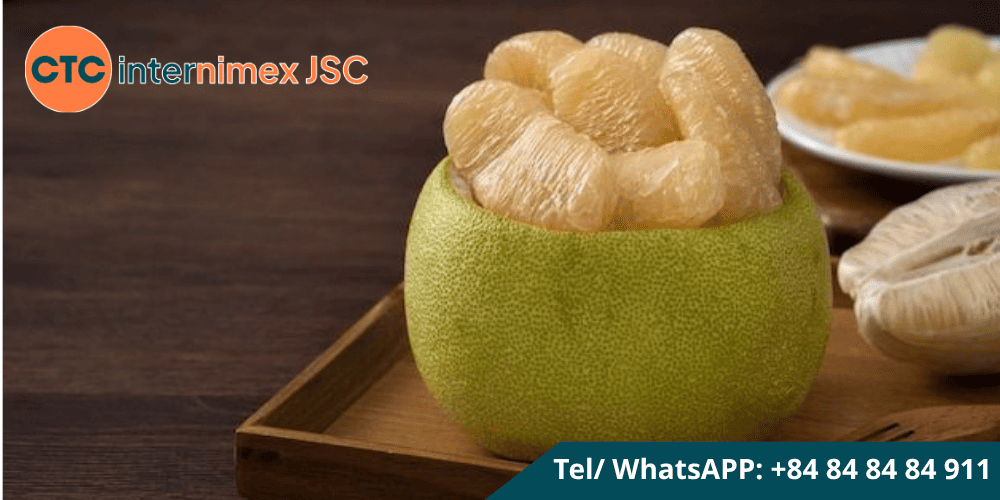
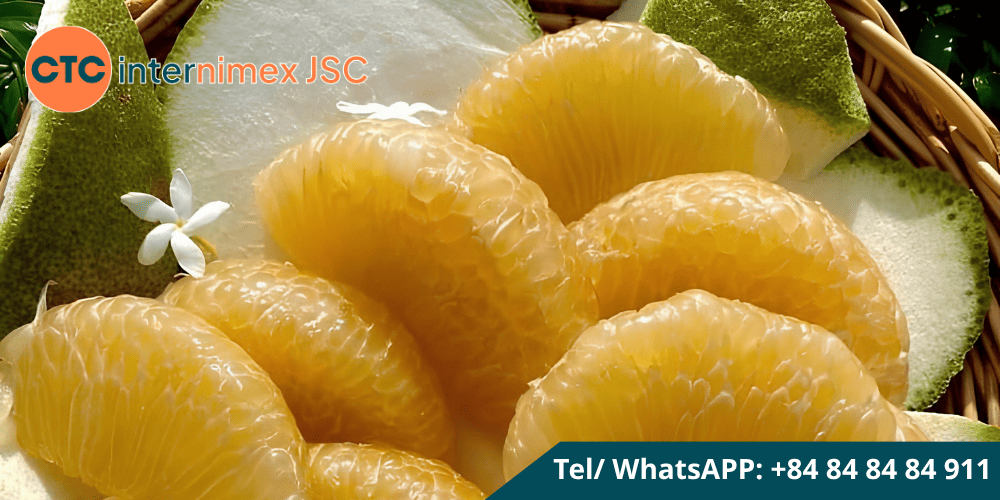
Internal Pulp Structure: Crisp, succulent ruby-pink segments that detach cleanly from the white pith without leaking juice.
-
Brix & Acid Balance: Natural sweetness ranging from 9.5° to 12.0° Brix, balanced with low acidity to prevent bitterness.
-
Seed Tolerance: Naturally seedless or containing minimal undeveloped seeds (averaging fewer than two seeds per fruit).
Produce Quality Baseline:
Export-grade fruit must feature a firm, taut rind free from mechanical punctures, sunburn marks, thrips blemishes, and scale insects. The button stem must remain firmly attached and trimmed flush with the shoulder to avoid puncturing adjacent fruits in the carton.
2. Step 1: Selective Harvesting & Gentle Field Transfer
Post-harvest quality preservation begins in the orchard. Proper field practices prevent micro-injuries that develop into fungal rot during sea freight:
-
Maturity Verification: Harvesting occurs strictly at physiological maturity (typically 210 to 220 days after flowering) to ensure optimal sugar accumulation and juice vesicle firmness.
-
Weather Discipline: Harvesting is conducted exclusively during dry morning hours once overnight dew has evaporated. Picking wet fruit ruptures essential oil glands in the flavedo (oleocellosis), causing dark blemishes during storage.
-
Two-Step Stem Clipping: Harvesters use sanitizing shears to sever the stem from the branch, followed by a second precision trim flush with the calyx button.
-
Cushioned Collection: Fruit is gathered in fabric-lined field crates rather than deep canvas sacks to eliminate compression bruising, then moved quickly to sheltered packing facilities.
3. Step 2: Washing, Sanitization & Fungicidal Rinsing
Upon entering the packing facility, every batch of green pomelo undergoes systematic washing to eliminate field contaminants and fungal inoculums:
-
De-Soiling Wash: Fruit passes across soft rotating roller brushes under clean water jets to remove surface dust and orchard residues.
-
Sanitizing Dip Bath: Fruit is immersed in a temperature-controlled bath containing food-grade sanitizing agents (such as peracetic acid at neutral pH) to neutralize decay pathogens like Phomopsis citri (stem-end rot) and Penicillium molds.
-
Controlled High-Velocity Air Drying: The washed fruit travels through a forced-air drying tunnel with low-heat blowers. The peel surface and stem cavity must be completely dry before wrapping, as residual water promotes mold growth inside shipping boxes.
4. Step 3: Natural Waxing, Protective Film & Individual Sleeving
Because green pomelo has a spongy white mesocarp (albedo), it is naturally prone to moisture transpiration over long journeys. Multi-barrier protection preserves internal weight and cosmetic appearance:
-
Protective Edible Waxing: A micro-spray of food-grade carnauba emulsion seals open stomata, reducing transpirational weight loss to under 2.0% across a 35-day voyage while maintaining the natural green sheen.
-
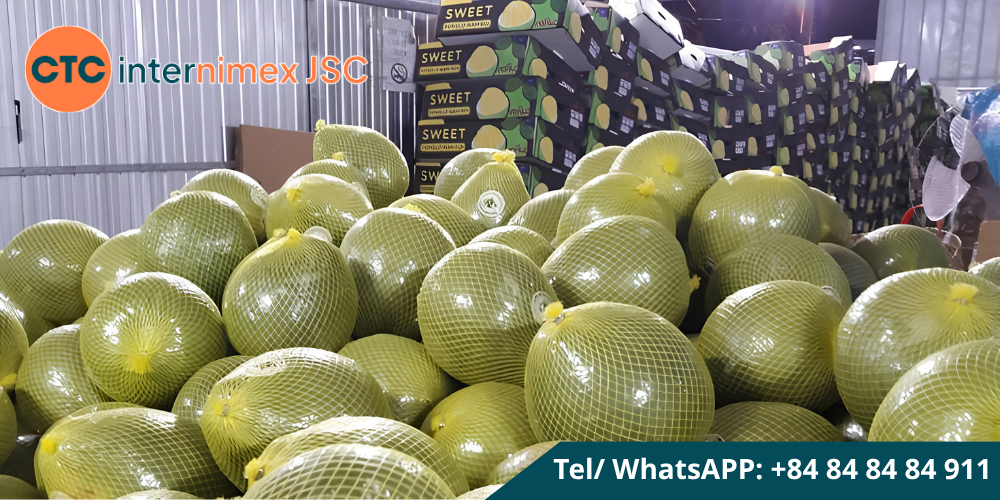
Micro-Perforated POF Shrink Film: Each fruit is sealed in breathable polyolefin shrink film. This wrap prevents fungal spores from spreading to neighboring fruits while maintaining a stable micro-humidity zone around the peel.
-
Expanded Polyethylene (EPE) Foam Netting: A soft foam net is fitted over each shrink-wrapped pomelo, absorbing road shocks and preventing friction abrasions between fruits during maritime transit.
| Protective Layer | Material Composition | Primary Functional Advantage |
| Layer 1: Wax Barrier | Food-grade carnauba emulsion | Seals natural stomata; slows respiration and moisture loss. |
| Layer 2: Individual Wrap | Breathable micro-perforated film | Traps humidity around peel; blocks spore cross-contamination. |
| Layer 3: Impact Sleeve | Expanded Polyethylene (EPE) net | Cushions transit vibration; prevents surface scuffing. |
| Layer 4: Master Box | 5-ply kraft corrugated carton | Carries vertical stacking weight; prevents fruit compression. |
5. Step 4: Export Packaging & Pallet Stabilization
Maritime reefer containers operate at 85% to 90% relative humidity. Corrugated boxes must withstand high vertical stacking loads without structural buckling:
Telescopic Master Cartons
-
Structure: Two-piece heavy-duty corrugated cartons with separate tops and bottoms providing double-wall vertical support.
-
Capacities: Standard net weight formats of 11 kg to 12 kg (containing 7 to 9 fruits) or 15 kg bulk cartons.
-
Board Construction: 5-ply kraft corrugated board reinforced with water-resistant adhesives to maintain high edge-crush strength.
-
Ventilation: Pre-cut air slots on side panels align vertically to allow continuous circulation of chilled reefer air.
Pallet Loading for 40ft High-Cube Reefer Containers
-
Pallet Dimensions: 100 x 120 cm (Industrial standard, 20–21 pallets per 40ft reefer).
-
Stacking Configuration: 8 to 10 tiers per pallet, aligned directly over pallet blocks.
-
Transit Stabilization: Reinforced with rigid full-length vertical V-board corner protectors and polyester straps.
-
Perforated Wrapping: Secured exclusively with macro-perforated stretch film to maintain continuous lateral air exchange. Solid plastic film is strictly avoided.
6. Step 5: Cold-Chain Management & Reefer Logistics
Temperature stability inside the container separates fresh green produce from unmarketable arrivals:
| Temperature Range | Physiological Impact on Green Pomelo | Commercial Outcome |
| Below +8.0°C | Causes chilling injury, peel pitting, albedo discoloration, and water-soaked lesions. | Commercial loss; fruit develops rapid rot upon rewarming. |
| Above +13.0°C | Accelerates respiration, activates latent fungal spores, and triggers rapid yellowing. | Fruit loses dark green identity, leading to heavy retail discounts. |
| Target: +9.0°C to +11.0°C | Induces physiological dormancy, preserves green rind color, and maintains pulp firmness. | Optimal arrival; maximizes retail shelf life at destination. |
Critical Temperature Warning for Importers:
Fresh green pomelo is sensitive to chilling injuries. The reefer temperature set point must remain locked between +9.0°C and +11.0°C with relative humidity at 85%–90%. Air vents should remain set at 15 to 25 CBM/hour to continuously purge respiratory ethylene and carbon dioxide.
7. Regulatory Compliance & Quality Verification
Every export consignment of green pomelo managed by CTC Internimex complies with international biosecurity frameworks:
-
Certified Farm Traceability: Sourced from orchards holding valid Planting Unit Codes (PUC) compliant with GlobalGAP guidelines for tracking and pest management.
-
Packinghouse Standards: Cleaned and boxed in facilities operating under Good Manufacturing Practices (GMP) and ISO 22000 hygiene baselines.
-
Chemical Safety Compliance: Managed responsibly to comply with destination-market Maximum Residue Limits (MRLs).
-
Third-Party Pre-Shipment Inspection: Batches can be verified prior to container stuffing by SGS, Vinacontrol, or Intertek for weight, grading compliance, and phytosanitary clearance.
-
Customs Documentation: Accompanied by official Phytosanitary Certificates, preferential Certificates of Origin (Form EUR.1, Form B, etc.), Commercial Invoices, and Ocean Bills of Lading.
8. Commercial Strengths of CTC Internimex JSC
Backed by nearly two decades of production, processing, and agricultural export operations, CTC Internimex JSC delivers reliable execution for international trade partners:
-
Direct Farm Sourcing: Long-term agreements with farming cooperatives in Ben Tre, Vinh Long, and Tien Giang ensure reliable weekly supplies of 5 to 10 containers without seasonal shortages.
-
Versatile Incoterms: Supporting adaptable trade arrangements: FOB (Ho Chi Minh / Cai Mep terminals), CIF / CFR (all primary global ports), EXW, and DDP.
-
Logistics Optimization: Direct contracts with major ocean carriers secure competitive freight rates and dependable container space during peak harvest windows.
-
Balanced Commercial Terms: Offering transparent payment solutions, including Telegraphic Transfers (T/T) and Irrevocable Letters of Credit at sight (L/C at sight).
9. 4-Step B2B Procurement Process
| Phase | Milestone | Operational Action |
| Step 01 | Technical RFQ | Buyer specifies target weight caliber (Grade Extra, 1, or 2), packaging style, volume, and destination discharge port. |
| Step 02 | Commercial Offer | CTC Internimex issues an itemized quotation; fresh fruit samples can be dispatched via airfreight for evaluation. |
| Step 03 | Sales Contract | Both parties ratify the formal sales agreement, confirm carton branding artwork, and lock in harvest schedules. |
| Step 04 | Stuffing & Release | Produce is graded, packed, verified by third-party inspectors, stuffed into reefer containers, and documents are released. |
10. Partner with CTC Internimex for Bulk Green Pomelo Supply
Whether you require customized private-label supermarket packaging or multi-container bulk shipments for regional wholesale distribution, CTC Internimex JSC delivers dependable agricultural quality and transparent commercial execution.
Learn more: Vietnamese Pomelo Export: Global Quality Fruit
Connect directly with our international export division today to discuss seasonal harvest schedules, review packinghouse audit credentials, or request a tailored quotation for your market:

Admin
 Green Pomelo: Proven Post-Harvest Steps for Best Reefer Export 2026
Admin
https://pos.nvncdn.com/f50e22-177505/store/20250801_V0TB7mvV.png?v=1754041486
Green Pomelo: Proven Post-Harvest Steps for Best Reefer Export 2026
Master green pomelo export with proven post-harvest steps for reefer transit in 2026. GlobalGAP certified, reliable supply by CTC.
Chia sẻ:
Bài viết mới nhất




Bình luận